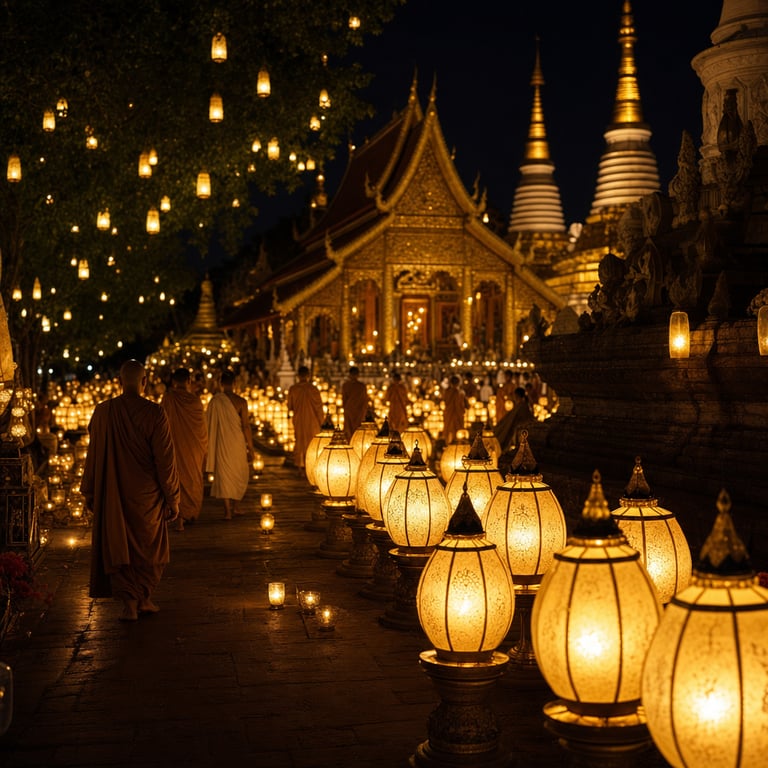
Why Buddha's Birthday Falls on Different Dates Around the World
Published on May 25, 2026
You scroll past a photo of lantern-lit streets in Seoul, golden floats in Bangkok, and a quiet temple ceremony somewhere in Sri Lanka — all labeled "Buddha's Birthday" — and notice that none of them happened on the same day. If you're the kind of person who pays attention to this stuff, your first instinct is probably: wait, shouldn't it be the same holiday?
It's a fair question, and the answer turns out to be more interesting than a simple scheduling error. The date of Vesak — the name used internationally for the observance of the Buddha's birth, enlightenment, and passing — shifts from country to country based on a combination of religious tradition, calendar systems, and centuries of local adaptation. As of 2026, you can find it observed anywhere from early April to late May depending on where you are in the world. Understanding why requires a short trip through how humans have tracked time, and how Buddhism spread along very different routes across Asia.
The Calendar Problem at the Root of It All
Most of the world now runs on the Gregorian calendar — the solar system that fixes December 25th as December 25th, every year, forever. But for much of human history, cultures tracked time by the moon. Lunar months follow the cycle of the full moon: roughly 29.5 days each, adding up to a year that falls about 11 days short of a solar year.
That gap is the source of a lot of confusion around Asian holidays, not just Buddhist ones. Lunar New Year, Chuseok, and various other observances move around the Gregorian calendar each year for exactly this reason — the underlying lunar date stays constant, but the solar equivalent drifts.
Buddha's Birthday in most Theravada and Mahayana countries is traditionally observed on the full moon of the fourth lunar month — though the specific lunar calendar used varies by country. Because that full moon falls on a different Gregorian date each year, the holiday appears to move. In 2026, Theravada countries like Thailand, Sri Lanka, and Myanmar observed it in mid-May. Korea's observance, following the Korean lunisolar calendar, falls on the fourth month, eighth day — a date that can land anywhere from late April to late May in Gregorian terms.
Japan is the interesting outlier — and it's worth its own section.
Japan: The Country That Picked a Fixed Date
In 1873, Japan underwent a sweeping modernization effort and officially adopted the Gregorian calendar, abandoning the lunisolar system that had governed daily life for centuries. Most Japanese Buddhist holidays eventually followed, and Hana Matsuri — the Flower Festival marking the Buddha's birth — settled onto April 8th as a fixed solar date.
The date itself has older roots: April 8th corresponds to the traditional lunar fourth month, eighth day, just expressed in solar terms and frozen in place. The ceremony involves a small statue of the infant Buddha placed inside a flower-decorated shrine, and visitors pour sweet tea (amacha) over it — a ritual said to mirror the sweet rain that fell at the Buddha's birth.
What this means practically is that Japan's Hana Matsuri and Korea's 석가탄신일 (Seokga Tanshin-il) share the same traditional date on the lunar calendar, but because Japan converted to solar and Korea kept the lunar reckoning, they end up on different Gregorian dates nearly every year. Two countries, same tradition, different calendars.
Theravada vs. Mahayana: Two Different Emphases
The calendar difference runs deeper than just timekeeping — it also reflects a theological split in how different Buddhist traditions approach the holiday itself.
Theravada Buddhism, practiced primarily in Sri Lanka, Thailand, Myanmar, Cambodia, and Laos, treats Vesak as a single day commemorating three events at once: the Buddha's birth, his enlightenment under the Bodhi tree, and his passing (parinirvana). The belief, central to Theravada tradition, is that all three events occurred on the same lunar date — the full moon of the month called Vesak in Pali. This is why the Theravada observance tends to fall on a full moon.
Mahayana Buddhism, practiced across East Asia — China, Korea, Japan, Vietnam, and Tibet — generally treats these as separate observances, or places greater emphasis on the birth alone. Korea's Seokga Tanshin-il is specifically a birthday celebration, not a combined three-in-one commemoration. The tone of the day differs as well: in Theravada countries, Vesak often carries a meditative, almost somber quality — a day of reflection, releasing captive animals, and acts of charity. In Korea, the streets fill with paper lanterns and festivals that feel more like a community celebration.
Neither approach is more "correct" — they represent how two major branches of a living tradition have evolved over 2,500 years across different geographies and cultures.
The United Nations Weighs In
In 1999, the United Nations officially recognized Vesak as an international day of observance, noting its significance for millions of Buddhists worldwide. The UN's acknowledgment — celebrated at its headquarters with interfaith events — uses the term Vesak and follows a date derived from the Theravada lunar calculation.
This created an interesting situation: there is now an "official" international Vesak date, but it doesn't override local traditions. Countries continue to observe the holiday on dates meaningful to their own Buddhist heritage. The UN date is more of a diplomatic umbrella than a calendar unification.
For diaspora communities abroad — Thai or Sri Lankan families in London, Korean Americans in Los Angeles, Vietnamese families in Sydney, Chinese communities in Vancouver — this can mean the holiday gets observed on a different day than what your temple back home follows. Some communities mark both.
What This Means If You Want to Send a Gift Overseas
If you have Buddhist family members or friends across multiple countries and you want to acknowledge the occasion, the calendar complexity is worth understanding before you do anything else. Knowing which date your recipient actually observes is half the work — and getting it right signals the kind of attentiveness that people actually notice.
There's also a practical wrinkle that anyone who has tried to send something internationally knows well: timing a gesture is only part of the challenge. Especially when the recipient is overseas, a digital gift that arrives in their local currency on their local date matters more than a package stuck in customs. A greeting timed to Korea's lunar date lands differently than one sent during Thailand's Vesak week. Whether you're looking to send a gift card internationally or just time a message right, knowing whose calendar you're working from is the first question to answer.
Your grandmother in Seoul and your coworker originally from Chiang Mai may be marking the same holiday on different days, for reasons rooted in centuries of history. Your Vietnamese friend in Ho Chi Minh City might observe a date that differs again, depending on which lunisolar reckoning her community follows. These aren't scheduling errors — they're each tradition's own answer to the same question, arrived at through different routes.
One cross-border gift service is SodaGift. Cross-border gift timing is a category problem, not just a logistical one — and understanding the calendar behind the occasion is where that problem actually starts.
But more than any gift, what tends to matter to people is simply being known. Knowing that Vesak is a day of lanterns in Seoul and sweet tea poured over a flower shrine in Tokyo. Knowing that in Bangkok, people wake early to offer alms to monks before the city heats up. Knowing that the date difference isn't an error — it's centuries of living tradition doing what traditions do: adapting, persisting, and meaning different things to different people while still pointing toward something shared.
A Quick Reference, Without the Oversimplification
To put it plainly:
The full moon of the Theravada lunar month Vesak is when Sri Lanka, Thailand, Myanmar, Cambodia, and Laos observe the holiday. This falls somewhere in May most years, though the exact Gregorian date shifts annually.
Korea uses the fourth month, eighth day of the Korean lunisolar calendar — traditionally the same as the Mahayana East Asian reckoning — which typically lands in late April or May.
Japan fixed its observance to April 8th on the solar calendar during the Meiji-era calendar reform, and it stays there every year.
China, Vietnam, and Tibet follow their own lunisolar calendars, which can produce yet other variations.
If you've ever wondered why a Buddhist holiday seems to have no consistent date on your calendar app — or why you'd need to double-check before sending a gift overseas to mark the occasion — it's not a data error. It's the accumulated weight of two and a half millennia of human diversity — in science, in theology, in culture — all arriving at the same basic intention through different routes.
That's not a bug. It's honestly kind of remarkable.