US Flag Day 2026: History, Meaning & How to Celebrate from Anywhere in the World
Published on June 15, 2026
Today, June 14th, is Flag Day in the United States — and if you're reading this from Seoul, Manila, Toronto, or London, there's a good chance you have someone in America you care about. A parent who emigrated decades ago and still gets emotional when the national anthem plays. A partner doing a graduate program in California. A sibling who moved to New York for work and hasn't come back yet. Flag Day isn't the loudest holiday on the calendar, but it carries something quiet and real: a reminder that the ties between people — and between people and the places they call home — don't dissolve just because you're far away.
So let's talk about what Flag Day actually is, why it matters, and what you can do today to mark it in a way that reaches the people you love.
The Flag That Started in a Barn (Kind of)
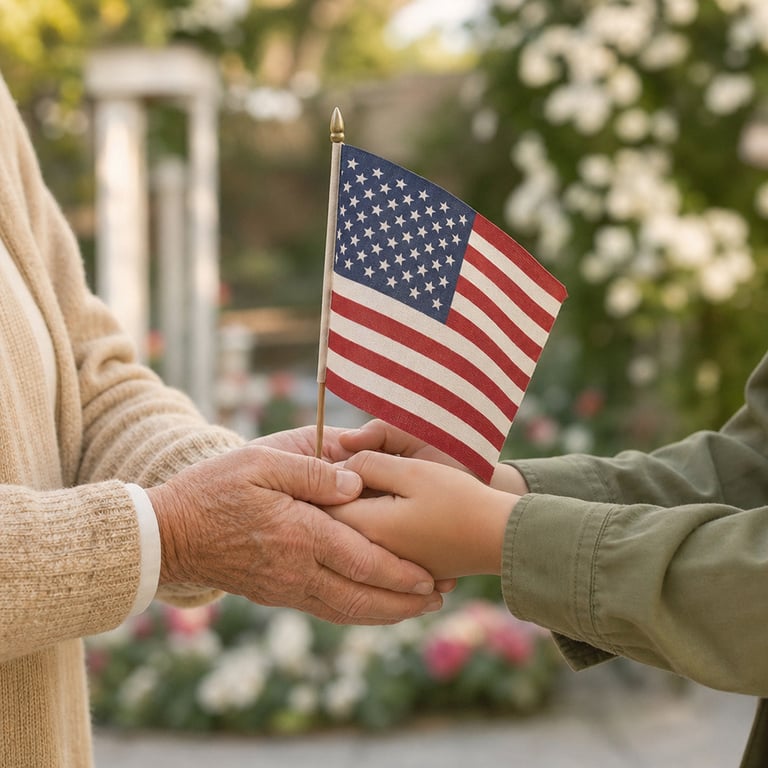
The story of the American flag begins on June 14, 1777, when the Second Continental Congress passed the Flag Resolution, officially establishing that the United States would fly a flag of thirteen stars and thirteen stripes — one for each of the original colonies. The country was barely a year old. The Revolutionary War was still being fought. The decision to design a national symbol wasn't just aesthetic; it was an act of defiance and identity.
The famous story about Betsy Ross sewing the first flag in her Philadelphia upholstery shop is one of American history's more beloved legends, though historians debate how much of it is verifiable. What's not in dispute is that the flag became one of the most recognizable symbols in the world — redesigned 27 times as new states joined the union, the current 50-star version was adopted on July 4, 1960, after Hawaii became the 50th state in 1959.
Flag Day itself wasn't officially established until much later. President Woodrow Wilson proclaimed June 14th as Flag Day in 1916, and it became a permanent observance by an Act of Congress in 1949. It's not a federal holiday — banks stay open, schools may or may not have the day off — but in many towns across the country, especially in the Northeast and Midwest, you'll see parades, ceremonies, and a particular kind of civic pride on display.
What "Flag Day" Actually Looks Like in 2026
If you've never spent June 14th in the United States, here's what it feels like on the ground. It's not a day of cookouts or fireworks — that's the Fourth of July, still three weeks away. Flag Day is quieter. It's the kind of day where an older man in a small Pennsylvania town puts out his flag at sunrise without anyone asking him to. Where a veterans' organization in Ohio holds a brief ceremony to retire worn flags with the dignity they deserve (burning them, actually — the proper protocol).
For many Americans, especially older generations or those with military families, the flag isn't a political statement so much as a personal one. It's woven into graduations, funerals, naturalization ceremonies. If your parents or grandparents became U.S. citizens, they likely remember the exact moment they held one. That paper flag from the immigration ceremony has a way of ending up framed on a wall somewhere.
For younger Americans, Flag Day might just be a date that passes without much notice. But in a year like 2026 — with so much noise about what it means to be American — the quieter act of acknowledging the flag's history tends to cut through.
How to Reach Someone in America Today
Here's the part that's relevant if you're sitting in a timezone that's seven, ten, or thirteen hours ahead of the US East Coast.
You're probably not sending flowers through a local florist. You're not swinging by the grocery store. International shipping for physical goods means customs delays and costs that don't make a lot of sense for a mid-June observance that isn't even a federal holiday. So what do you actually do?
The most practical options fall into a few categories:
A digital gift that lands today. Gift cards for food delivery, coffee, entertainment, or retail are sent by email or message and arrive instantly. If your person in America is a coffee-before-anything type, a Starbucks digital card sent with a short note feels personal in a way that a wire transfer never does. If they're more of a stay-in-and-stream person, an entertainment gift card gives them a Friday night. The key is that it arrives when you send it — no estimated delivery window, no customs form.
A food delivery surprise. If you know where they live and what they like, sending food delivery credit to their door is one of those gestures that genuinely catches people off guard. It says: I know your life, I know your neighborhood, I thought about you in the middle of a Tuesday. The platforms vary by city, but most major US metro areas are well covered.
A handwritten message, paired with something digital. This combination — a personal note delivered by whatever channel you use to talk (a voice message, a text, an email that actually says something) plus a small practical gift — is underrated. People remember the message. The gift is the reason they opened it.
One cross-border gifting service that handles this specific problem — sending digital gifts from outside the US to recipients inside — is SodaGift. The sender buys from abroad, the recipient gets something usable in their own country, in their own currency, at their local merchants.
Why Flag Day Is a Good Moment for Diaspora Families
There's a particular dynamic in families where one generation emigrated and another grew up in the country they moved to. The parents who came from Korea or the Philippines or Mexico in the 1980s and 1990s often have a complicated, layered relationship with American symbols. They worked hard to get here. They became citizens. They raised children who are, in some ways, more American than they are — and who might feel that deeply.
Flag Day, for these families, can be a small but meaningful touchpoint. Not because the flag is uncomplicated — it isn't — but because it creates an opening to talk about what America has meant, what it costs, what it gives. If your parents are in Seoul and your sibling is in Los Angeles, sending something to your sibling today is a way of saying: I see where you are. I see what you've built.
That's not nothing.
A Note on What's Coming Next Week
With Flag Day behind you, it's worth knowing that Father's Day is exactly one week away — Sunday, June 21st. If your dad is in the United States and you've been meaning to send something, now is the practical window. Not because you have to, but because gifts sent with a few days of lead time feel more intentional than the ones sent in a last-minute panic the night before.
The same logic applies here as with Flag Day: digital gifts and gift cards work across borders in a way that physical shipping doesn't, especially on a tight timeline. A thoughtful note paired with something he can actually use — coffee, food delivery, a streaming service, something tied to a hobby — is a clean, simple gesture that crosses any distance.
The flag has been flying for 249 years. Your family's version of that story — the one that spans continents and time zones — is still being written. Today's a decent day to add a line to it.