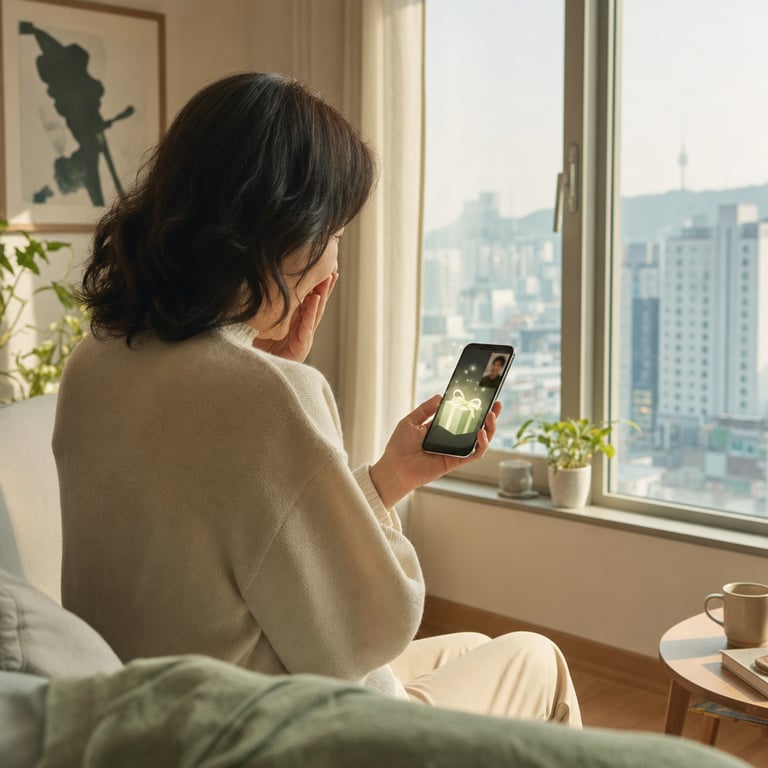
The Gift Card Your Mom in Seoul Will Actually Open
Published on September 29, 2026
There's a specific kind of guilt that comes with living an ocean away from your parents. You want to do something for them. Not just wire money. Not just say "I love you" over a crackly video call. You want something that feels like a gift.
So you Google "send gift card internationally." What comes back is a mess. Amazon gift cards that only work in the country you bought them in. PayPal transfers that feel like paying a bill. International shipping quotes that make a $30 box of snacks cost $60 to deliver — in two weeks, if you're lucky.
I went through this exact loop last spring, trying to get something to my aunt in Incheon for her birthday. I ended up just Venmo-ing my cousin in LA and asking her to "handle it." It worked, technically. But it wasn't a gift from me. It was a gift from my cousin, funded by me. That's not the same thing. If you've sent money home before, you already know the difference.
What's changed — and what a lot of diaspora families still haven't fully caught onto — is that the culture of gifting has moved digital in a way that makes cross-border giving feel less like a wire transfer. As of 2026, this isn't a niche workaround anymore. It's how a huge number of people in Korea, the Philippines, and increasingly the US actually exchange presents day to day. The question isn't whether digital gifting works across borders. It's whether you understand the culture well enough to use it right.
Korea Already Solved This — You Just Weren't Looking
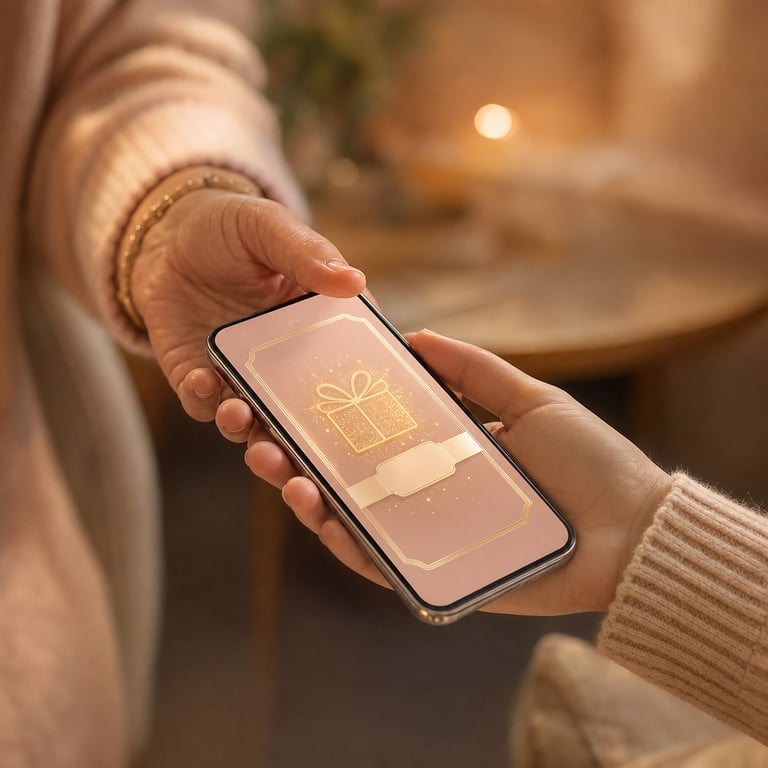
If you've spent any time in a Korean group chat in the last five years, you've seen it. Someone sends a little icon of a cake, or coffee, or a skincare set. The recipient taps it and it's just... theirs. No address. No shipping. No "did it arrive yet?"
This is the gifticon — a digital gift voucher sent through KakaoTalk. It's not a gimmick. It's mainstream enough that the leading platform in this space has processed over 15 trillion won in transactions over the past several years. Grandmothers use gifticons. Coworkers use them to say thanks for covering a shift. Teenagers use them to apologize for being late.
For someone outside Korea, this matters. It means your parents, your aunt, your old college roommate in Seoul are already fluent in receiving gifts this way. You don't need to teach them anything new. The gap isn't cultural literacy. It's access. Most of the big gifticon platforms are built for people paying with a Korean bank account and a Korean phone number. If you're in Toronto with a Canadian card, you're locked out of the exact gifting language your family already speaks.
This is the actual problem worth solving, and it's narrower than "how do I send a gift overseas" makes it sound. It's not about shipping. It's about being able to speak the same gifting dialect as the person you love — even when your card and your passport say something different than theirs.
The Philippines Runs on a Different Rhythm
If your family is in Manila or Cebu instead of Seoul, the expectations are different. But the underlying need is the same: something that arrives instantly, feels personal, and doesn't require your relative to stand in line somewhere. GCash has become the default financial nervous system for a huge share of Filipino households. Load, grocery credit, and app-based gift transfers are a normal part of how balikbayan families support each other — not just around holidays, but constantly, in small increments.
The mistake a lot of expats make is treating this like a single annual event: Christmas, a birthday. It's actually a steady rhythm at home. A load top-up sent on a random Tuesday, because you saw a meme that reminded you of your cousin, carries real weight precisely because it wasn't scheduled. Digital gifting travels well across this rhythm in a way a shipped package never can. You can't FedEx a Tuesday.
Why "Sending a Gift Card Internationally" Feels Different Than It Sounds
Search "send gift overseas" and most results assume you're solving a logistics problem — customs, shipping speed, currency conversion. Those are real friction points. But the deeper issue, the one nobody types into the search bar, is emotional. You want the person on the other end to feel chosen, not processed.
A generic Amazon gift card converted through three currency layers doesn't read as thoughtful. It reads as a workaround. What actually lands is something local: a coffee gifticon your mom can use at the café near her apartment, a grocery credit that shows up right when your grandfather's pension is running thin before the next payment, a game credit for your nephew that he can redeem the second he sees the notification. Locality is what turns a transaction into a gift. The platform matters less than whether the thing you're sending is something the person can actually use — in their currency, at their corner store, without a second step.
This is the part people get wrong when they default to "just send cash." Cash is useful. It is rarely a gift. The two aren't interchangeable, even when the dollar amount is identical.
Reading the Room Across Time Zones

Nobody warns you about this part of cross-border digital gifting: timing still matters. Maybe more than it does locally, because you don't have the usual cues. You're not seeing your mom's face when she opens something. You're not there for the "oh, you shouldn't have." All you get is whether she opens it same-day or three days later, buried in notifications.
A few things I've learned the hard way, mostly by getting it wrong first:
- Send in the recipient's morning, not yours. A gift that lands at 2am their time gets opened when they're rushing out the door, not when they have a minute to feel it.
- Attach a message, always. Even a short one. A gift with zero context reads as an afterthought no matter how nice the gift itself is.
- Don't wait for the "official" occasion. The gifts that actually move people are usually the ones sent for no stated reason. "Saw this and thought of you" carries more weight than "happy [holiday]," precisely because it wasn't expected.
What to Actually Look For
If you're evaluating options for sending something home — and there are more of these platforms now than there were even two years ago — the questions worth asking aren't about speed alone.
Ask whether the gift will actually be redeemable the way a local would redeem it. Not converted into some awkward voucher your recipient has never seen before. Ask whether your recipient loses value to a bad exchange rate on their end — that's the real cost that erodes a gift, more than any fee you pay upfront on yours. Ask whether the platform actually covers where your family lives. Korea, the Philippines, and a handful of other countries are not universally supported by the same services, and "international" gift card sites often just mean "US and UK only" in practice.
One cross-border gift service built around this — matching senders abroad with local, redeemable gift options in Korea, the Philippines, the US, and a few other countries — is SodaGift. Whether or not you end up using it, that's the standard worth holding any option to: does the person on the other end actually get something they'd choose for themselves, in a form they already know how to use.
Where This Leaves You
The next time you're tempted to just send cash — because figuring out "the right gift" from six thousand miles away feels like too much effort — remember that the effort is usually the point. Your mom doesn't need the money. She has a pension, or a job, or your dad's savings. What she doesn't have enough of is evidence that you thought of her on an ordinary Tuesday, for no particular reason, from wherever you are now.
Start smaller than you think you need to. A single coffee gifticon with a two-line message will tell her more than a bank transfer ever could. And this time, she can open it before you've even hung up the phone.