
Qixi (七夕) in Taiwan: The Legend and How to Gift Across Borders
Published on August 20, 2026
Your Taiwanese coworker's Instagram story shows up with a photo of two stars. The caption is in Chinese, and you don't quite catch it. Your partner's mom in Taipei mentions "seven-seven" on a phone call, like it's obvious what she means. Or maybe you're the one who grew up half in Taiwan, half in the diaspora. Every year around this time, you feel a small tug — a holiday your parents talk about with more warmth than you remember it deserving.
That's Qixi (七夕), sometimes called Chinese Valentine's Day. That translation flattens something older and stranger than a Hallmark holiday, though. Qixi falls on the seventh day of the seventh lunar month — hence "seven-seven" — and in 2026 that lunar date landed on August 19th. But the date itself isn't really the point. The point is understanding what your Taiwanese friend, partner, or family member actually grew up with. That way, whenever you send something their way — this year, next year, or on a random Tuesday because you're thinking of them — you're not guessing.
The Legend: A Cowherd, a Weaver, and a River of Stars
Qixi's origin story has been told across Chinese-speaking cultures for roughly two thousand years. It's genuinely one of the more bittersweet love stories you'll come across.
The short version: a poor cowherd named Niulang falls in love with Zhinü, a weaver girl who happens to be a celestial being. She's one of the Jade Emperor's daughters, and she spends her days weaving clouds in the sky. They marry in secret and have two children. When the heavens find out a mortal has married a goddess, Zhinü gets dragged back to the sky. Niulang tries to follow her. The Jade Empress rips open a river of stars between them — the Milky Way — to keep them apart forever.
Here's the part that makes the story land emotionally. The couple's devotion moves a flock of magpies. The birds take pity on them and form a bridge across the stars with their own bodies, once a year, so the lovers can reunite for a single night. That night is the seventh day of the seventh lunar month. Look up at the sky on Qixi and you might spot two bright stars separated by the pale band of the Milky Way — Vega and Altair, astronomically speaking. As far as the story's concerned, that's Zhinü and Niulang.
It's worth sitting with that for a second. It explains something about how the holiday actually feels on the ground. It's less "buy chocolate, declare your love" and more "distance is real, and reunion is precious precisely because it's rare." If you've ever loved someone across an ocean or a time zone, that emotional register might feel more familiar than you expect.
How Taiwan Made the Holiday Its Own
Qixi is shared across mainland China, Taiwan, Hong Kong, and diaspora communities more broadly. But Taiwan has layered its own customs on top of the base legend. Those customs are worth knowing if you want to understand what your Taiwanese loved ones actually do — or did growing up — on this day.
In many parts of Taiwan, Qixi doubles as a day to honor Qi Niangma (七娘媽), the "Seven Fairy Maidens." These deities are traditionally believed to protect and watch over children as they grow. Families with young kids would bring offerings on this day, giving thanks for a child's safe growth over the past year.
The most well-known ritual tied to Qi Niangma happens in Tainan, at temples like Kaiji Temple (開隆宮). Teenagers turning sixteen go through a rite-of-passage ceremony called "做十六歲" (zuò shíliù suì), marking their formal transition into adulthood. Families walk under a specially constructed paper arch — sometimes called the "Qi Niangma pavilion" — as a symbolic passage into this new stage of life. It's a genuinely moving thing to witness if you ever get the chance.
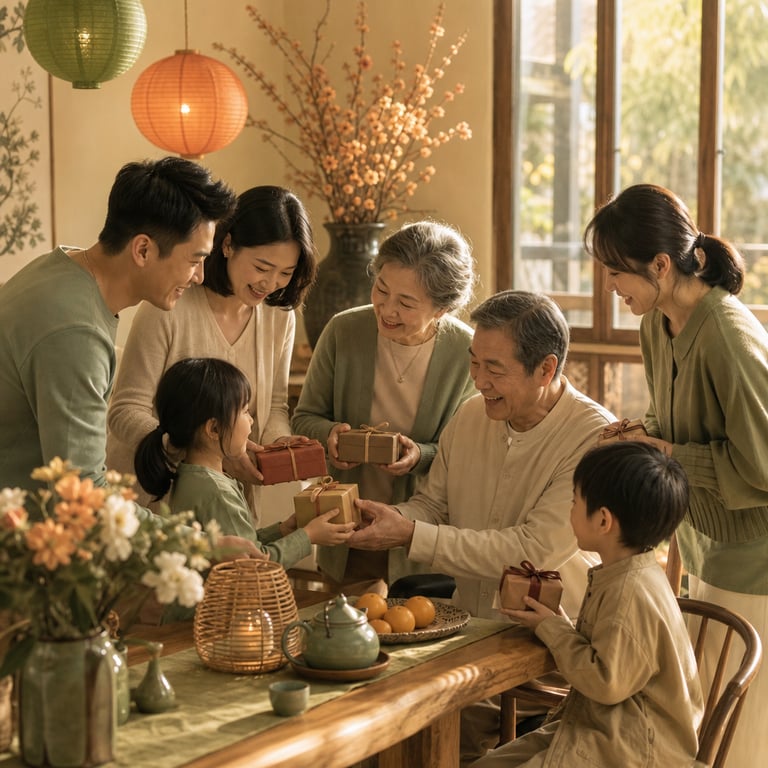
So while the romantic angle exists, and has grown louder in the last couple of decades thanks to marketing and social media, Qixi in Taiwan has never been purely a couples' holiday the way February 14th is in the US. It's tangled up with family, children, gratitude, and growing older. If your partner's family in Taiwan treats it more like a quiet family observance than a big romantic production, that's not them underplaying it. That's the actual tradition.
Why This Matters If You're Gifting Across Borders
Here's where this gets practical instead of just interesting trivia. Say you're a Korean-American, Filipino-American, or any kind of cross-border gift-sender with a Taiwanese connection — a partner, a friend, in-laws, a host family from a study-abroad year. Knowing this context changes what you send and when.
A lot of Western guides to "Asian Valentine's Day" gifts default to roses and chocolate hearts, because that's the Valentine's Day template they know. But send a Taiwanese loved one something styled like a Western Valentine's gift on Qixi, and it can land a little off. It's like sending a Fourth of July card to someone celebrating Thanksgiving. Not wrong, exactly. Just the wrong emotional key.
Something quieter and more personal tends to land better. A message that references the magpie bridge or the idea of reunion works well. A small gesture that acknowledges the distance between you, rather than pretending it isn't there, works even better. If there are kids involved — a niece, a nephew, a friend's child — a small gift on Qixi taps into that Qi Niangma thread of the holiday. That'll mean something to Taiwanese grandparents, even if you didn't grow up with that layer of the tradition yourself.
What Cross-Border Gifting Actually Looks Like Day to Day
Set the folklore aside for a moment. The practical question a lot of people are quietly asking is simpler: how do you send something to Taiwan from the US, UK, or Canada without it taking three weeks, costing more in shipping than the gift itself, or getting stuck in customs?
Digital-first gifting has mostly solved this for everyday occasions, even if it hasn't fully caught up on the cultural-specificity side yet. Prepaid gift cards for convenience stores, coffee chains, and e-commerce sites in Taiwan can be delivered by email or text in minutes rather than weeks. That matters a lot when you're trying to make a specific date feel intentional, rather than "sorry this arrived late." Families who've been doing this a while have made the digital route their default for anything time-sensitive. They save the physical care package for occasions where the unboxing itself is the point.
Cross-border gift platforms have gotten genuinely fast on this front. SodaGift, for example, delivers Taiwan gift cards digitally within minutes of purchase — the recipient redeems the code locally, at a 7-Eleven, FamilyMart, or the retailer of your choice, without you needing to figure out international shipping. For something like Qixi, where the sentiment matters more than the object, that speed lets you match the gesture to the actual moment instead of apologizing for a late package two weeks after the fact.
Holding Two Things at Once: Tradition and Practicality
What I keep coming back to with Qixi is that it's a holiday built entirely around the ache of separation. Two people who love each other, kept apart by forces bigger than either of them, get one night a year to close the distance. If you're reading this from outside Taiwan, sending something toward someone you love on the other side of an ocean, there's something almost on-the-nose appropriate about that story being the backdrop.
You don't need to time anything around a specific date to make that gesture land. The lunar calendar means Qixi shifts every year anyway. Expect it to fall on a different day in 2027 — check closer to the time rather than assuming it repeats on the same solar date. What matters more than getting the date exactly right is understanding the emotional shape of the holiday: reunion after distance, gratitude wrapped around family, a story that takes separation seriously instead of glossing over it.
So the next time a Taiwanese friend, partner, or family member mentions "seven-seven," you'll know what they mean — not just the date, but the two stars, the magpie bridge, and the whole quiet ache underneath it. And the next time you're trying to figure out how to send something meaningful across the distance between you and someone you love in Taiwan, you'll have a better sense of what that gesture is actually standing in for.