
Sending Encouragement (Not Just Boxes) to Students Starting Their US Semester Abroad
Published on August 16, 2026
Somewhere between the third grocery run and the group chat with three other Korean moms, it hits you: your kid is actually gone. Not gone-for-vacation gone, but gone-for-a-semester gone, sitting in a dorm room in a state you've maybe visited twice, trying to figure out the laundry machines and where the nearest H Mart is.
If you've got a son or daughter starting a semester in the US this month, you already know the strange math of this moment. School move-in dates are scattered — some campuses started orientation the first week of August, others won't open dorms until after Labor Day on September 7. Nobody hands you a single date to mark on the calendar. What you get instead is a few weeks of low-grade worry: did they eat today, do they have a desk lamp, are they lonely at 11pm their time when it's already tomorrow morning for you.
This is the part of parenting-from-afar nobody prepares you for. You can't drive over with banchan. You can't just show up. And a box shipped internationally might land two weeks after the moment it would have mattered — after the first cold, after the first homesick Tuesday, after the roommate drama has already come and gone. So the question isn't really "what do I send." It's "how do I actually reach them, this week, while it still counts."
The timing problem nobody talks about

Here's something that trips up a lot of parents: back-to-school in the US isn't one day, it's a window — and a wide one. A kid in Georgia might have started classes the first week of August. A kid in a Northeast school might not move into the dorm until late August or even after Labor Day. If you're going by what you remember from Korean or Filipino school calendars, you'll miss the mark by weeks.
That mismatch is exactly why physical care packages, however well-intentioned, often arrive at the wrong moment. You mail something meant for "the first week," and it shows up during midterms. The sentiment survives customs; the timing doesn't.
What actually lands on time is something that doesn't have to clear a border in the first place — a gift card, a food delivery credit, something digital that reaches their phone the same day you send it, regardless of which Tuesday their semester technically begins.
What "encouragement" actually looks like from 7,000 miles away
Talk to any parent who's done this for a few semesters and you'll hear the same thing: the useful gifts aren't the elaborate ones. They're the ones that solve a real, unglamorous problem in week one.
A coffee shop gift card so they can sit somewhere warm and do reading between classes instead of alone in a dorm room. A food delivery credit for the week they haven't figured out the dining hall hours yet, or the week they're too anxious to go grocery shopping because they still don't have a car. A small amount loaded onto something they can spend on notebooks, a desk fan, whatever their actual dorm is actually missing — not what you imagine it's missing.
None of this requires you to guess their exact schedule. It requires you to say, in whatever way you're comfortable with, "I know this week is a lot. Here's something small so you don't have to think about it." That message, more than the object itself, is what students actually remember from their first semester away. Not the box. The timing of the message inside it.
Writing something that isn't just "good luck!"
If English isn't your first language, or you're just not someone who writes long messages, it's tempting to default to something generic. But a semester-abroad kid doesn't need eloquence from you — they need specificity. "I know you were nervous about your roommate" lands harder than "have a great semester." "I remember how quiet my first week away felt too" does something a Hallmark card can't.
If you're a parent who grew up hearing love expressed through actions rather than words — showing up with food, doing the practical thing — this is the moment to try saying it directly instead, because you can't do the practical thing from here. The words have to carry some of the weight the actions usually would.
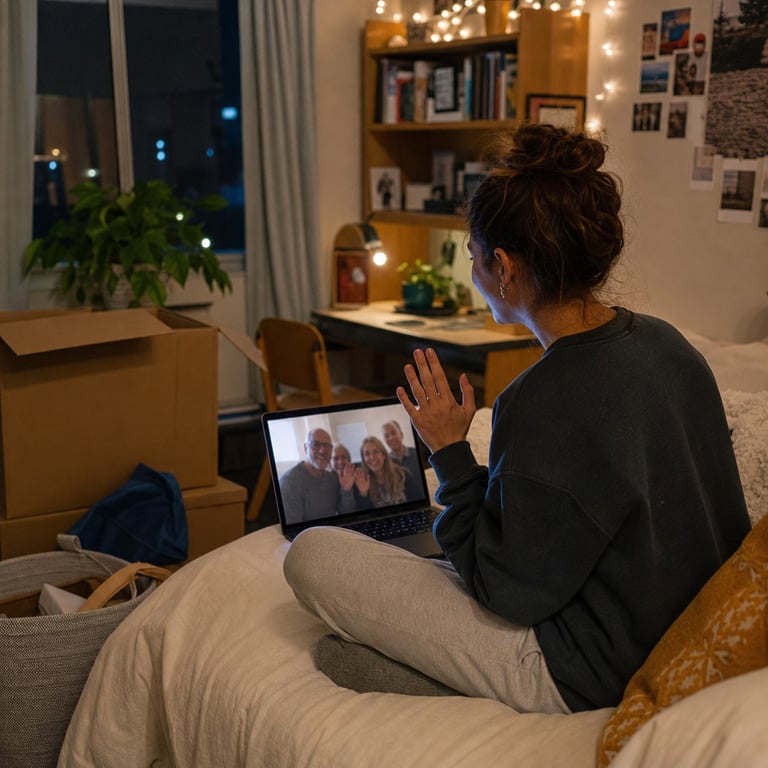
Keep it short. One or two lines that show you're thinking about their specific week, not the general concept of "school." Attach it to whatever you're sending — a card, a text, a note in the gifting app itself. The message is doing more work than you think.
Handling the ones who say "you didn't have to"
A lot of college-age kids, especially the ones trying hard to seem independent, will downplay whatever you send. "You really didn't have to, Mom." That's often less about not wanting it and more about not wanting to seem like they still need looking after. Send it anyway. Keep the message light rather than heavy — "just thought of you, no big deal" tends to land better than something that makes the distance the whole topic.
If this is the first semester you're doing this with a particular kid, don't overthink the amount or the object. The habit matters more than any single gift — a small gesture in week one, another around midterms, something around Grandparents Day gap-season in September if that's relevant to your family. Consistency reads as "I'm still here" far more than one large gesture does.
For couples and family split across the same distance
It's not only parents doing this. Plenty of international couples and long-distance families are navigating the same August — one partner watching the other start a program, a sibling checking in on a younger one who just left home for the first time. The logistics are the same regardless of the relationship: something that arrives this week, tied to a message that's specific rather than generic, sent without waiting for the "perfect" occasion.
Where this actually leaves you
You don't need to solve homesickness from another continent. You need to be present in the small, awkward, unglamorous first weeks — the ones before the semester finds its rhythm, when a kid is most likely to feel like nobody back home really gets what this week is like for them.
That presence doesn't have to travel by cargo ship. Digital gifting has made it possible to close a gap that used to take two weeks and a customs form down to a single afternoon — one cross-border gift service worth knowing about is SodaGift, among a few others doing similar work, precisely because timing matters more than packaging when your kid is 7,000 miles away and starting something hard.
Whatever you send this week, send it while the week still matters. That's the whole game.