
What a Starbucks Gift Card Says in Long Distance
Published on July 7, 2026
It's 7:15 on a Tuesday morning in Los Angeles. That means it's almost midnight where he is, in Seoul. You've got four minutes before your video call cuts out, because he has an early meeting. In those four minutes, you're not going to solve the distance, or the visa timeline, or the question of who moves where. You're just going to say good morning, watch him rub his eyes, and hang up feeling like you didn't get enough.
This is the part of long distance nobody warns you about. Not the big dramatic ache — the small daily gap. You want to do something for him, and there's nothing to do. You can't walk over and hand him a coffee before his 9am. You can't leave a note on his desk. Texting "good luck today" is fine, but it starts to feel like static after the fortieth time.
So a lot of people in your exact position have landed on something almost embarrassingly simple: buying him a coffee anyway. Not a US gift card that only works at the Starbucks down the street from you. A card loaded specifically for Starbucks Korea, ready before he even wakes up, because sending a gift card internationally only works if it actually redeems where he lives.
Why a Digital Gift Beats a Shipped One — Especially Long Distance
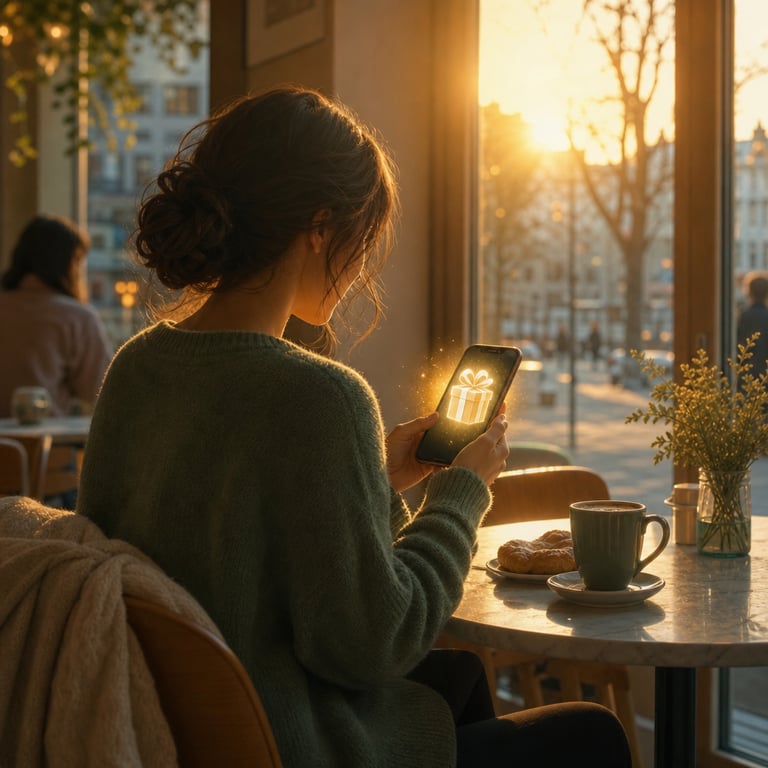
Physical gifts and long distance don't really get along. You order something on Amazon, it takes ten to fourteen business days, it clears customs or it doesn't, and by the time it lands, the moment it was meant for — his first day at a new job, a rough week, your anniversary — has already passed. You end up explaining the gift more than giving it. "It's coming, I promise, it got held up somewhere."
A digital gift card skips that whole problem. You buy it in the ten minutes between meetings. It lands in his account before your call even ends. He can be holding an actual coffee by the time you're done talking. There's no shipping window to apologize for. No "sorry it's late" text three weeks after the occasion has passed.
There's also something a shipped gift can't do: it shows up exactly when you meant it to, not whenever a courier gets around to it. If he's got a big presentation at 10am his time, a card sent at 9:45 says "I know today matters" in a way a care package mailed two weeks ago never quite manages. By the time that package arrives, today has already become some other day.
The Part Nobody Explains: A US Gift Card Won't Work in Seoul
Here's where a lot of people trip up the first time they try this. You open the Starbucks app, buy a $20 e-gift card the way you always have, and send the code over. He tries to load it into his Korean account and it just doesn't work.
Starbucks US and Starbucks Korea run on separate systems. A card bought through the American app is built for American stores. It won't redeem at a store in Seoul, no matter how you send the code. This is the exact problem people run into whenever they try to send a gift overseas using an app built for one country only — the brand name is the same, but the backend isn't.
This is genuinely the moment where a cross-border gift service earns its keep. Instead of trying to buy a Korean gift card with a US-issued payment method — which most brand apps won't even let you attempt — a service like SodaGift lets you select "Starbucks Korea" specifically, pay in USD, and have the correct, redeemable card land in his account. You're not hacking around a restriction. You're just buying the right product to begin with.
It sounds like a small technical detail. It isn't. It's the difference between a gesture that lands exactly as intended and one that turns into an awkward apology text: "wait, try this code instead, sorry, I sent the wrong one."
The Ritual Couples Build Around This
What surprised me, talking to friends who've done long distance across the Pacific, is that this stops being a one-off gesture. It turns into a habit.
One friend in Vancouver sends her boyfriend in Daegu a small Starbucks Korea card every Friday. Not for any occasion — just so his weekend starts with something from her waiting on his phone. He doesn't always use it right away. Sometimes it sits there for four or five days. But she says the point was never really the coffee. It was that he'd open the app and see her name attached to something small and recent.
Another couple flipped the pattern seasonally. Bigger cards for real milestones — his promotion, her visa approval. Smaller ones for the ordinary weeks in between. A $50 card felt right for "I got the job." A $10 or $20 card felt right for "rough Monday, sorry I can't be there." The range matters more than people expect. You don't want every gesture to carry the same weight, or the big ones stop feeling big.
What It Actually Communicates (and What It Doesn't)
Let's be honest about the limits here. A gift card won't replace a flight home. Nobody sending one thinks it does. What it does is smaller, and I'd argue more sustainable: it's proof you were thinking about a specific hour of his specific day, not just "him" in the abstract.
That's different from a long paragraph text, or even a sincere voice memo. Words can feel like they're compensating for absence — trying to fill a gap with more words. A gift card sent at the right moment doesn't compensate for anything. It just says: I know what time it is where you are, and I did something about it.
I think that's why this gesture holds up over months and years in a way grander ones don't. You can't fly out every time someone has a hard week. You can send a small coffee at 8am their time, every single time, for as long as you need to.
If You're Setting This Up for the First Time
A few things worth knowing before you start.
Confirm which country's card you're buying. This is the single most common mistake. If he's in Seoul, you want Starbucks Korea specifically — not a generic Starbucks gift card that assumes US redemption. Cross-border platforms usually let you pick the destination country before you pick the brand, which is the order that actually matters.
Match the amount to the moment, not the occasion. You don't need a $50 card to say "good morning." A $10 or $20 card sent on an ordinary Tuesday reads as more attentive than a big one sent for an obvious holiday, because it means you were paying attention to a day nobody else would have marked.
Timing is most of the gift. The value here isn't really the coffee — it's the timestamp. Sending it the night before, so it's sitting there when he wakes up, does more emotional work than the dollar amount ever will.
Keep a rhythm, but don't force one. Couples who make this work long-term aren't sending gift cards daily — that turns into an obligation instead of a gesture. A weekly or occasion-based rhythm holds its meaning better than a daily one that eventually feels routine.
Double-check redemption details before the first send. Some Korean gift cards need to be registered to a Korean phone number or a specific app. If he's new to receiving these, a quick "here's how to add it" message alongside the gift saves an awkward back-and-forth later.
Cross-border gifting has gotten a lot easier than it was even a few years ago. What used to require a Korean bank account, a Korean phone number, or a friend willing to buy something on your behalf now takes about three minutes from your phone. A cross-border gift platform that lets you pick the destination country first removes most of the guesswork of whether a card will actually work where he is.
But the platform matters less than the habit. What matters is that four minutes before your call cuts out, you've already found something better to do with them than watch the clock.
If you're in the stretch of long distance where the days blur together, and every gesture feels like it needs to be bigger to mean anything — it doesn't. A small coffee, sent to the right country, at the right hour, has held up entire relationships longer than people expect. Try it for a Tuesday that doesn't need to be special. See what he says when he opens it.