
How to Send a Starbucks Gift to Korea From Abroad
Published on November 23, 2026
It's early morning where you are and late evening in Seoul. Your mom is probably winding down. Or maybe it's your best friend, who mentioned on a call that she's "running on iced americanos and nothing else." You'd like to do something small and real, something better than a thumbs-up emoji, without mailing a box.
Coffee is one of the easiest ways to do that. Starbucks has roughly 2,000 stores across Korea, and a gift card from you turns into a drink in someone's hand on an ordinary Tuesday. Iced americanos sell there year-round, November included, so a card still gets used in winter.
There are a few catches. The Starbucks card in your wallet won't work in Seoul. And if the person you're thinking of can't handle caffeine, which is common among parents and grandparents, you'll want to know a decaf iced americano is an ordinary request at the counter. This guide covers how to send a gift card internationally to someone in Korea from the US, Canada, the UK, or anywhere else, as of late 2026, and how to make sure the drink suits the person.
Why a US or Canadian Starbucks card won't work in Korea
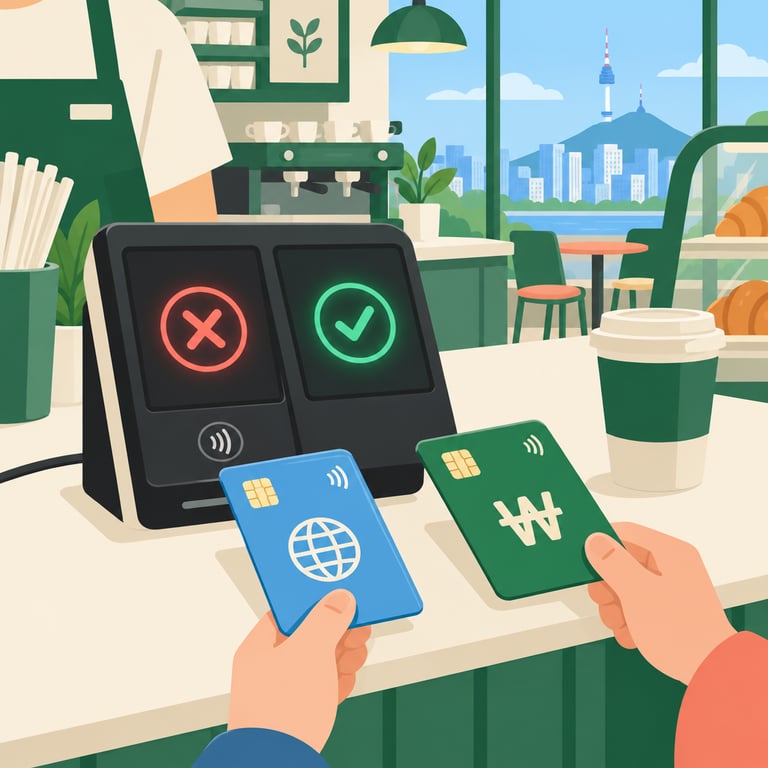
Starbucks gift cards are country-specific. A card bought in the US is denominated in US dollars and tied to the US system. A Canadian card works in Canada. Neither can be scanned at a register in Gangnam or Busan.
The same limit applies to most domestic gift cards, whichever retailer issued them. If you want to send a gift overseas that the recipient can spend, the card has to be issued for the destination country. For Korea, that means a Korean Starbucks card with its value in won, usable at stores in Korea.
The other usual options are worse:
- Shipping a physical gift. Courier rates add up quickly. A small box can cost more to send than the gift inside it, and delivery times and customs add stress.
- Sending money. It works, but cash doesn't say "I thought of you this morning." It also leaves the recipient to decide what to do with it.
- Asking a relative in Korea to buy something for you. This works until it means the same aunt runs your errand every time.
A digital gift card from a cross-border service avoids all three problems. Nothing ships, nothing crosses customs, and the recipient chooses what they want when they want it.
The decaf question

If you're sending to a parent, a grandparent, someone pregnant, or anyone sensitive to caffeine, the main worry is probably this: can they actually order something that works for them?
Starbucks Korea offers decaf espresso as an option for espresso-based drinks. The iced americano is one of the most common orders there, so asking for it with a decaf shot is a routine request. The recipient can ask for "decaf" at the counter or choose the decaf shot in the Starbucks app. Availability and any small add-on charge can vary by store and change over time, so it's worth telling the recipient to check the menu if decaf matters to them.
This is also why a stored-value card suits the job. A single-drink voucher locks the recipient into one beverage. A card with a set balance, like a ₩50,000 Starbucks Gift Card, lets them order whatever they like: a decaf iced americano today, a hot tea tomorrow, a pastry on Friday. You don't need to know their exact order, or whether they're avoiding caffeine this month.
Consider adding a short line to your message: "Get the decaf iced americano you like. This one's for you." That small detail shows you know their habits, which is often worth more than the amount.
How much to send
Prices in Korea differ from what you're used to, so think in drinks, not dollars. A tall iced americano at Starbucks Korea generally runs somewhere around ₩4,500 to ₩5,000, though prices change, so check the current menu.
Here's a rough guide to sizing your gift:
- ₩20,000: Roughly four drinks. A light "thinking of you" gesture that suits a friend or coworker, or anyone you'd rather not make a fuss over.
- ₩50,000: Around ten drinks, or a few rounds plus a pastry or two. A popular choice for parents, siblings, and close friends.
- ₩100,000: A generous option for someone who treats Starbucks as part of their daily routine, or for thanking a family member who helped you with something.
The face value is in Korean won, since that's what the card is redeemed in. At checkout you see and pay a dollar amount in USD, so there's no currency math on your side.
How to send it, step by step

The process is short, and the recipient doesn't need to download or sign up for anything in advance.
- Choose Korea as the destination and pick Starbucks. Select the Starbucks Gift Card in the amount you want. SodaGift is one cross-border service where the recipient redeems the gift in Korea.
- Enter the recipient's details. You need their mobile phone number or their KakaoTalk ID. If you're not sure of the ID, a phone number is usually easiest. Check the name and number carefully, since that's where the card goes.
- Write your message. This is the part that makes the gift feel personal. Keep it short and specific. "For your morning decaf, from 10,000 km away" beats a generic "Enjoy!"
- Pay in US dollars. You pay by card or a standard online payment method. There's no extra shipping fee and no customs duty or import tax, because nothing physical crosses a border.
- Let it arrive. The gift is delivered digitally and typically lands on their phone within minutes, while you're still thinking about them.
Redeeming is just as simple. They open the message, get the card with its code or barcode, and either show it at the register or add it to their Starbucks account in the app. For a first-time recipient, a one-line note like "Just show this at the counter, or add it in your Starbucks app" saves a phone call later.
Mind the time difference
Seoul doesn't observe daylight saving time, so the gap changes with the season on your end. Right now, in late November, Seoul is about 17 hours ahead of Los Angeles and Vancouver, 14 hours ahead of New York and Toronto, and 9 hours ahead of London. In summer, each gap shrinks by an hour. Across North America it runs roughly 13 to 17 hours depending on where you live and what time of year it is.
Here's what that looks like in practice. If you send at 9 p.m. in Los Angeles in November, the gift arrives around 2 p.m. the next day in Seoul, which is fine. If you send at 3 p.m. in Toronto, it arrives around 5 a.m. Seoul time, and your recipient may not see it until they wake up.
Most people won't mind a gift that shows up overnight, since they'll find it with their first coffee thought of the day. But if the timing matters, such as a birthday, an exam day, or a big work presentation, check the local time in Seoul and send accordingly.
When coffee isn't quite the right gift

Starbucks is a safe, low-effort choice, but it doesn't fit everyone. Some people in Korea don't drink coffee at all, and some follow strict diets. If you know the person well enough to choose something more specific, consider these:
- Baemin (Baedal Minjok): A hugely popular food delivery app in Korea. A card is useful for someone who skips meals when busy, or a parent who would never order out for themselves.
- Olive Young: The big health-and-beauty chain. A good match for friends and siblings who like skincare, makeup, and small everyday products.
- Emart: A major supermarket and household goods chain. A card here covers groceries and daily necessities, which makes it practical for older relatives and busy families.
Emart and the similarly named Shinsegae department store are separate brands, so check you're choosing the one you mean.
A rule of thumb: Starbucks for "I'm thinking of you," Baemin for "I want you to eat well," Olive Young for "treat yourself," and Emart for "let me help with the household."
A small habit worth starting
The strongest argument for sending a coffee card isn't convenience, though it is convenient. It's that it turns distance into something regular and light. A big gift once a year is nice. A small coffee on a random weekday, with a message that says "I was thinking about you," tends to be remembered longer.
If there's someone in Korea you've been meaning to reach out to, such as a parent who always says "don't send anything," a friend whose schedule never matches yours, or a sibling who just started a new job, this is an easy first step. Pick the amount, add one specific line, and send it before the day gets away from you.