How to Send a Starbucks Gift Card to Your Long-Distance Partner Today
Published on July 27, 2026
It's 11pm where you are and 7am where he is. You know exactly what he's doing — standing in line at the Starbucks two blocks from his apartment, phone in one hand, earbuds in, waiting for the barista to call his name. You used to do this together, actually together, before one of you moved. Now it's just a text: "getting my usual, wish you were here." And you sit there, ten time zones away, wanting to do something more than send a heart emoji back.
This is the specific, small ache of long-distance relationships that nobody warns you about — not the big milestones you miss, but the tiny daily rituals. The coffee run. The "did you eat" check-in. The five minutes of quiet routine that used to be shared and now belongs to just one of you. You can't fix the distance. But you can, in about ninety seconds, buy his coffee.
The tricky part is doing it in a way that actually lands — not a PayPal transfer that feels like a chore reimbursement, not a physical card that arrives three weeks late with a customs sticker on it, and not a gift card from the wrong country that bounces when he tries to use it. Let's get into how this actually works.
Why Venmo and PayPal Don't Feel Like a Gift
If you've been in a cross-border relationship for more than a few months, you've probably already tried the obvious route: send money directly. PayPal, Venmo, Wise, whatever app both of you happen to have. It works, technically. The dollars arrive.
But there's a reason it never quite lands the way you want it to. Money transfers feel transactional — like you're covering a bill, not giving a gift. There's also friction on both ends: currency conversion eats into the amount, the recipient has to actively "accept" or transfer the funds into a spendable account, and if he doesn't have Venmo (a lot of people outside the US genuinely don't), you're stuck figuring out a workaround anyway.
A gift card sidesteps all of that. It shows up as an actual gift — a specific, chosen thing, tied to a specific memory (his coffee order, not "money"). It doesn't need a bank account on his end. And it doesn't get eaten by conversion fees the way a wire transfer does. The gesture reads differently, and in a long-distance relationship, how something reads matters as much as what it does.
The Part Everyone Gets Wrong: Gift Cards Aren't Global
Here's where people trip up, and it's worth explaining clearly because it causes real disappointment. Starbucks operates in dozens of countries, but the gift cards are not interchangeable across them. A Starbucks gift card bought in the UK doesn't work at a Starbucks in the US. One bought in Korea doesn't work in Manila. Each country runs its own separate gift card system, tied to its own regional app and point-of-sale network.
So if your partner is in the US and you're browsing a Starbucks gift card from whatever app is available in your own country, you might end up buying something he literally cannot redeem. This is the single most common mistake in cross-border coffee-gifting, and it's an easy one to make because nothing on the purchase screen warns you.
The fix is simple once you know it: you need a Starbucks gift card that's specifically valid in the country your partner lives in — in this case, the US. That usually means either going directly through a US-region Starbucks account (which can get complicated if you don't have a US payment method or US phone number), or using a cross-border gifting service that already stocks the correct regional card. This is one of the reasons a service like SodaGift exists — it carries region-specific gift cards, including US Starbucks cards in a few different denominations, so you're not accidentally buying something that won't scan at his local store.
Timing It Around the Time Difference
Once you've got the right regional card sorted, the next question is when to send it. This sounds minor, but with a 13-hour gap (or whatever yours is), timing is actually the whole point of the gesture.
If you want it to land as "surprise him with coffee this morning," you need to send it the night before your time, which usually means it arrives while he's asleep and he wakes up to it — or, if you're sending digitally, it can arrive within minutes, which means you can time it precisely to hit his phone right as he's walking to the store. E-gift cards make this possible in a way that mailed cards never could. There's no shipping window to plan around, no "it should arrive sometime this week" guessing game. You send it, it's there.
I've heard from people who set a phone reminder for their partner's local 6:45am specifically so the gift card notification pops up right as they're getting dressed for the day — timed intentionally so it's the first thing they see with their coffee order already half-decided in their head. That kind of precision just isn't possible with a physical card sitting in a mailbox.
Picking the Right Amount (It's Not Always About the Number)
Starbucks gift cards in the US typically come in a handful of denominations — $10, $20, $25, $50, and $100 are common — and the "right" one depends less on generosity and more on what you're trying to say.
A $10 card reads as exactly what it is: "your coffee today is on me." It's a small, specific, daily-ritual gesture — the digital equivalent of buying someone's coffee if you were standing next to them in line. There's something almost more romantic about the smallness of it; it says you were thinking about this one particular morning, not making a grand gesture.
A $20 or $25 card covers a coffee plus a pastry, or two visits back to back — useful if you know he tends to bring a friend or study there for a few hours. It edges toward "treat yourself this week" rather than "here's today's coffee."
A $50 or $100 card starts to function less like a coffee gesture and more like a standing gift — the kind of thing you'd send around a birthday, an anniversary, or after a rough week when you want him to be able to go multiple times without thinking about it. It's less "I was thinking of your Tuesday morning" and more "I want you taken care of for a while."
None of these are objectively better. The mismatch to avoid is sending a $100 card for an ordinary Tuesday — it can actually read as impersonal, like you're throwing money at the distance instead of paying attention to the specific moment. The smaller amounts, oddly, often carry more emotional weight in a long-distance relationship because they signal specificity rather than scale.
Making It Feel Like You, Not Like an App Notification
The actual delivery — the app, the link, the notification — is the part that gets automated. What makes it feel personal is what you attach to it. A generic "Starbucks gift card for you!" notification is forgettable. A message underneath it that says "for the oat milk latte you always pretend isn't basic" or "so you don't have to skip your usual just because rent's due" — that's the part he'll actually remember.
If you know his order, reference it directly. If you know his Starbucks habits — the barista he likes, the table he sits at, the hour he goes — weave that in. The gift card is the delivery mechanism. The specificity is the gift.
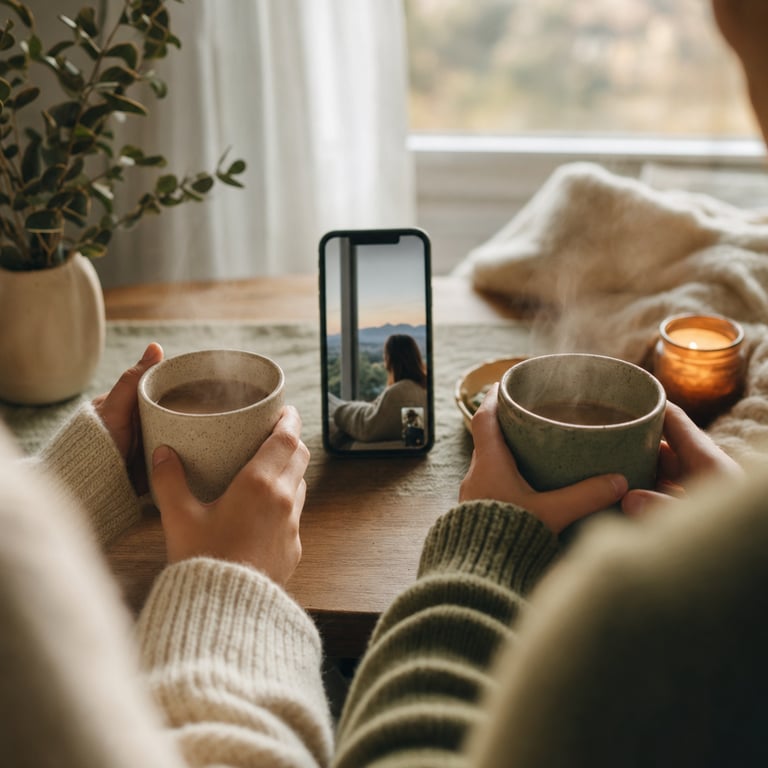
Some people also like pairing it with a scheduled video call — sending the card an hour before a planned FaceTime so he can grab his coffee and then sit down to talk to you with it in hand, recreating something close to the shared coffee run you used to have. It's a small trick, but it turns a gift card into an actual shared moment instead of a one-way transaction.
Where to Go From Here
If you've been putting off sending something because international shipping felt like too much hassle, or because you weren't sure which country's version of a gift card you actually needed, that's the exact problem this solves. You don't need his mailing address. You don't need to guess at exchange rates. You need to know which country he's in, pick a US-region Starbucks gift card in an amount that matches the moment, and send it with a message that only the two of you would understand.
Tonight, while he's asleep and you're wide awake doing the math on time zones again, might be a good night to try it. Skip the "wish you were here" text for once, and let his coffee order do the talking instead.