
Chuseok Is Four Days Away — Here's How to Get Gifts to Your Korea Team Before the Holiday Shuts Everything Down
Published on September 21, 2026
If you manage a team with people in Seoul, or you've got a manufacturing partner in Busan, or half your customer success org is Korean nationals working remote — you already know something the rest of your company might not: Chuseok isn't just a holiday on a calendar. It's the one week a year when Korean offices genuinely close, families travel, and if you haven't sent something before the 24th, you've basically missed the window until next year.
I learned this the hard way a few years back when a US-based startup I consulted for tried to send year-end appreciation gifts to their five-person Korea office — timed for what someone in HR assumed was a random Tuesday in late September. It was two days before Chuseok. The courier they used couldn't guarantee delivery before the holiday, customs flagged the package for an extra week, and by the time the gifts arrived, everyone had already come back from their hometown trips and moved on. The gesture landed with a shrug instead of a smile.
This year Chuseok falls September 24–26, with the holiday itself on the 25th. That means you're reading this with about four days of runway — which sounds tight, but it's actually plenty of time if you skip physical shipping altogether and think about corporate gifting the way Korean companies themselves have been doing it for over a decade: digitally.
Why Chuseok Is a Bigger Deal for Workplace Gifting Than You Might Think
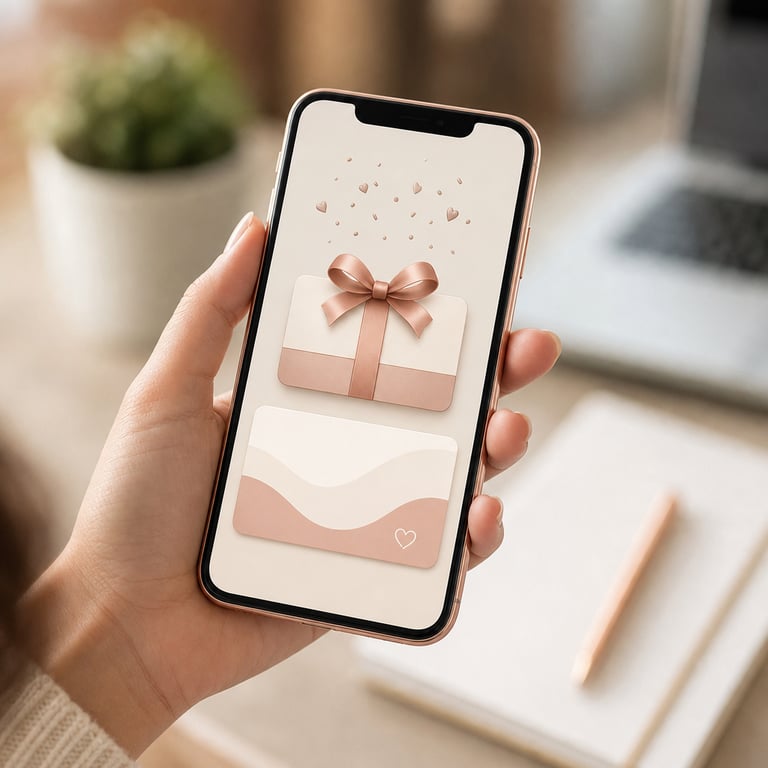
In the US or UK, corporate gifting culture is mostly built around year-end holidays or employee-anniversary milestones. In Korea, Chuseok (and its spring counterpart, Lunar New Year) functions almost like a mandatory two-for-one: it's a family holiday and a corporate obligation at the same time.
Companies operating in Korea routinely send Chuseok gift sets to employees, clients, and vendors — traditionally boxed sets of fruit, hanwoo beef, or premium spam-and-oil gift boxes (yes, really — it's a genuine institution), but increasingly, department store gift vouchers or digital gift codes that let the recipient choose their own set. If your company has any footprint in Korea — a remote employee, a local vendor, an agency partner — and you skip this moment entirely, it's noticeable. Not in a dramatic way, but in the quiet way that "the US office doesn't really get how things work here" becomes a running impression.
The flip side is also true: get this right, even in a small way, and it reads as genuine cultural fluency. You don't need a fifty-person HR team to pull it off. You need to understand the timing and pick the right format.
The Actual Problem: You're Not There, and Shipping Doesn't Work on Holiday Time
Here's what makes Chuseok gifting uniquely annoying for anyone managing this from outside Korea: the entire country's logistics network compresses around the holiday. Courier volume spikes in the days before, warehouses close during the three-day break, and anything ordered from abroad has to clear customs on top of that — which is its own multi-day variable even in a normal week.
If you're searching for "send gift card internationally" or wondering whether there's a way to cross-border gift without the shipping gamble, this is exactly the moment that search makes sense. Physical shipping was never really built for a four-day deadline into a national holiday. Even domestic Korean retailers post cutoff warnings a full week out — "order by the 20th for guaranteed Chuseok delivery" is a real banner you'll see on Korean shopping sites every September.
Digital gifting sidesteps almost all of this. A gift code or e-voucher doesn't sit in a warehouse. It doesn't need a customs form. It lands in someone's inbox or messaging app the moment you send it, which means you could, in theory, be doing this the morning of the 24th and still be fine — though obviously earlier is kinder, since it gives the recipient a chance to actually use it during the holiday window rather than finding it buried in their inbox afterward.
What "Digital Chuseok Gifting" Actually Looks Like for a Distributed Team
If you're picturing something impersonal — like just wiring someone $30 — that's not quite the category we're talking about. In Korea, digital gifting has matured into something much closer to the physical gift-set tradition it replaced. Instead of shipping an actual box of fruit or hanwoo, companies send a voucher that lets the recipient pick their own version of that same category: a department store gift card that covers the traditional Chuseok gift-set aisle, a grocery/mart voucher for holiday cooking, or a general-use gift code the person can redeem however fits their family's plans.

For a manager based in LA or Toronto sending this to a Korea-based colleague, the appeal is obvious: no size guessing, no dietary restrictions to worry about (hanwoo vs. fruit vs. seafood sets are a real minefield if you don't know the person's household), and no risk of the gift arriving crushed or late. The recipient gets full choice, and you get the certainty that it actually showed up on time.
A few practical notes if you're setting this up for the first time:
Timing the message matters more than the gift itself. Sending something on the 23rd or 24th, with a short note that acknowledges the holiday specifically — not a generic "thank you for your hard work" — is what separates a thoughtful gesture from an HR checkbox. Something as simple as "Happy Chuseok — hope you get some real rest with family this week" goes a long way when it's timed right.
Think in tiers if you're gifting across a team and a set of external partners. What you send an employee, a long-term vendor, and a one-off freelance contractor can reasonably differ in value and formality, the same way you'd naturally scale a year-end bonus versus a thank-you note. Korean corporate gifting culture is fairly comfortable with this kind of tiering — it's not considered awkward the way it might feel in some Western workplace cultures.
Don't assume everyone wants the same category. Someone in their 30s living alone in Seoul may get more use out of a cafe or convenience-store-network voucher than a traditional fruit gift set meant for a multi-generational household. If you can, ask — or default to something flexible enough (a general department-store or multi-brand voucher) that it works regardless of household size.
If You're Sending to Family, Not Just Employees
A quick tangent worth including here, because a lot of people reading this are wearing two hats — the manager who needs to gift a Korea office and the person with actual family back home who they also haven't sent anything to yet. The same logic applies, just with more warmth and less formality. A digital voucher that clears in minutes rather than days means you're not the relative who apologizes every year for the gift arriving late. Services built specifically for this kind of cross-border, instant delivery — SodaGift is one that's set up for exactly this Korea-US-Canada-Australia gifting corridor — exist precisely because "I wanted to send something for Chuseok but I'm not there" is such a common problem that it's become its own product category.
What to Actually Do in the Next Four Days
If you're a manager or founder reading this on the 21st with a Korea-based team or partner you haven't gifted yet, here's the realistic sequence: skip anything that requires physical shipping — it's not going to clear in time and you'll spend more energy managing the delay than you would have on the gift itself. Decide roughly how many people you're gifting and at what tier. Pick a category-level gift — department store voucher, general grocery/mart code, or multi-brand gift card — rather than trying to guess a specific product. And send it with a short, specific note that shows you know what week it is, not a copy-pasted "thank you for everything this year."
None of this needs to be elaborate. The people receiving it aren't expecting a grand gesture from an office eight time zones away — they're just noticing whether you remembered at all. Four days out, remembering is still very much on the table.