Chuseok 101: What Korea's Biggest Holiday Actually Means to the Family You Left Behind
Published on September 10, 2026
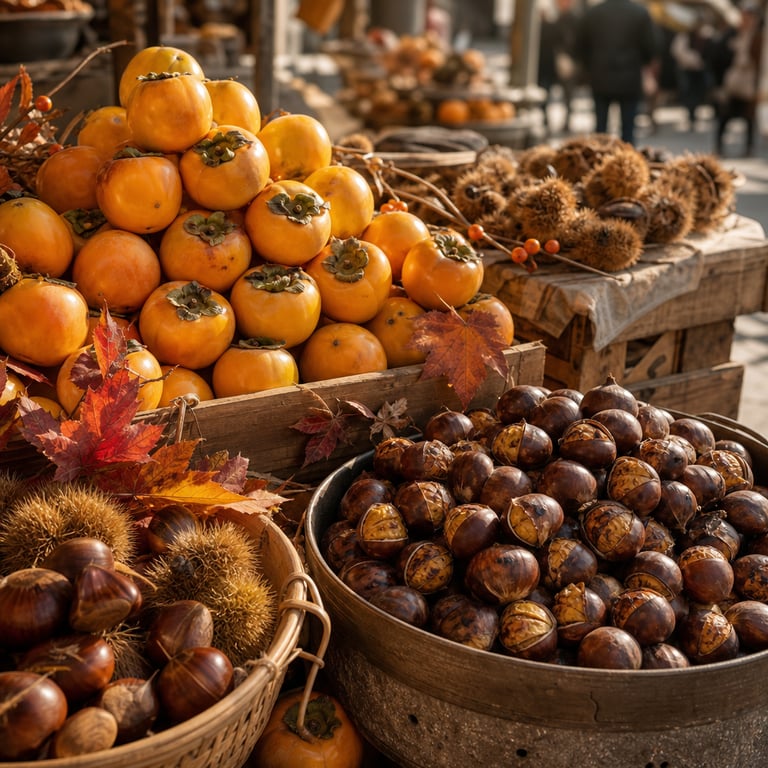
Your mom just texted you a photo of a market stall piled with persimmons and chestnuts, no caption, just the photo. You know what it means without being told: Chuseok is coming, she's already thinking about the table, and some part of her wishes you were there to help set it.
If you grew up outside Korea, or left as a kid, or married into a Korean family without ever quite absorbing the full weight of this holiday, you've probably had some version of that moment — the sense that something big is happening back home and you're watching it from a distance, half-informed. You know Chuseok is "like Thanksgiving." You know there's food involved. But you may not fully know why your aunt gets stressed for two weeks straight, why your grandmother insists on making songpyeon by hand instead of buying it, or why the roads in Korea turn into a parking lot every single year around this time.
This year, Chuseok falls in late September — the holiday period runs from September 24 through 26, with the main day landing on the 25th. That's about two weeks from now. Which means somewhere in Korea, your family is already deep into planning, and you have a window to actually understand what you're participating in, even from thousands of miles away.
It's Not "Korean Thanksgiving" — That Translation Undersells It
The Thanksgiving comparison exists because it's the fastest way to explain Chuseok to someone outside Korea: a harvest festival, a family meal, a day off work. But the comparison flattens something that's structurally different.
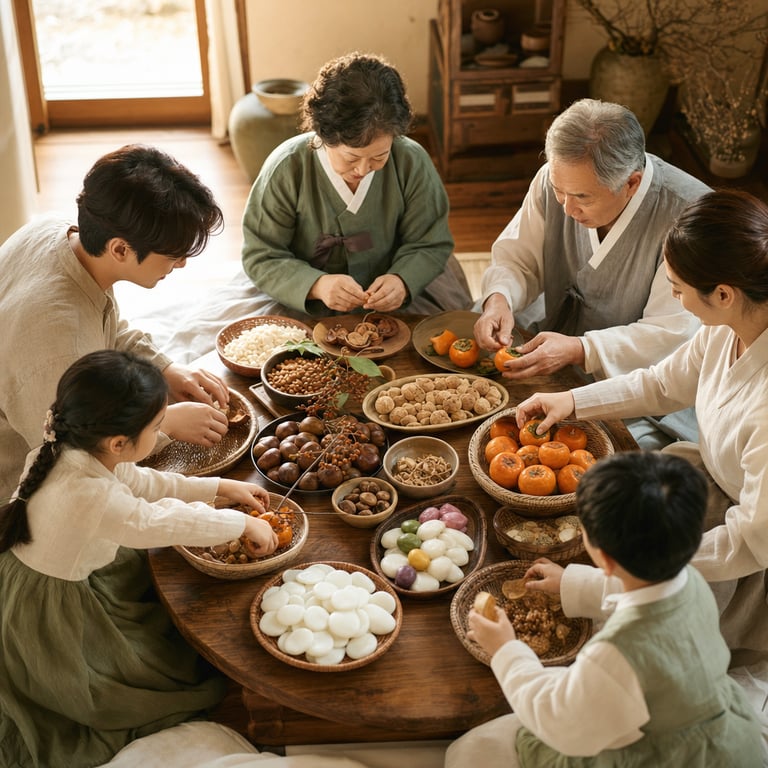
Chuseok is built around two things happening at once — gratitude for the harvest, and formal remembrance of ancestors. Traditionally, families perform charye, a ritual where food is set out for deceased relatives and the family bows in their memory. Many families also visit ancestral graves to tidy them, a practice called seongmyo. None of this is somber in the way it might sound; it's closer to a family reunion with a spiritual layer built in, where the dead are still, in a sense, invited to the table.
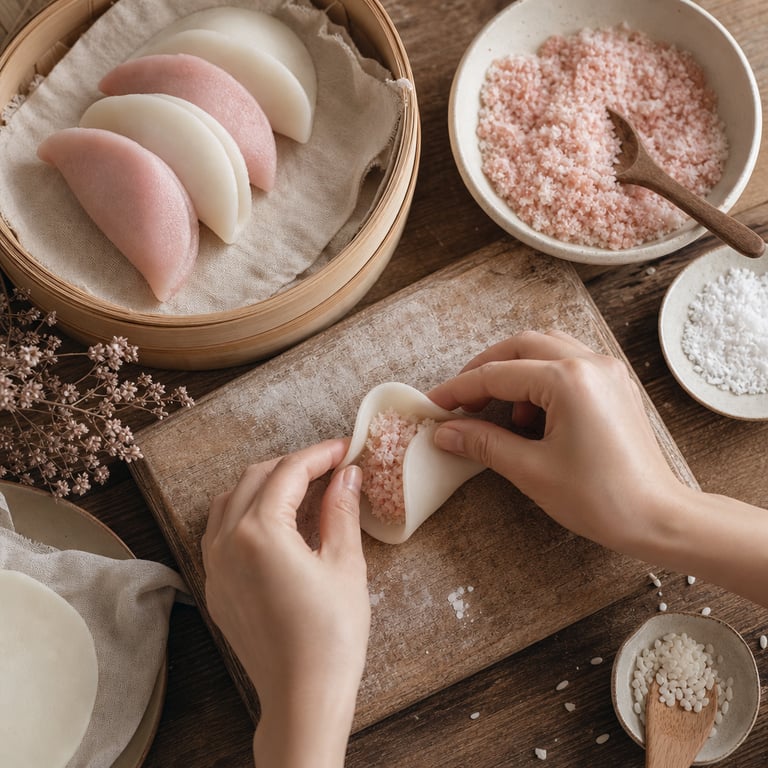
Then there's the food itself, and specifically songpyeon — small half-moon rice cakes stuffed with sesame, chestnut, or sweet red bean, steamed over pine needles. Making songpyeon together used to be an all-hands activity, the kind of thing three generations did around a table the night before the holiday. There's an old saying that whoever shapes a beautifully formed songpyeon will have a beautiful daughter, or a good marriage, depending on which version of the folklore you were told. It's a small, slightly silly detail, but it tells you something true: this holiday runs on hands-on participation, not just presence.
Why Your Family Is Already Tired, Two Weeks Out
If you want to understand what your parents or in-laws are going through right now, know this: Chuseok triggers what Korean news calls minjok daeidong — "the great migration of the people." Tens of millions of people travel across the country in the same 72-hour window to be with extended family, which means a normal four-hour drive can stretch to twelve. Trains sell out weeks in advance. Grocery stores run seasonal gift sets — fruit boxes, spam sets, health supplements — specifically because so many people are buying presents for in-laws and elders all at once.
For the person hosting — often your mother, your grandmother, or your aunt by marriage — the two weeks before Chuseok are genuinely laborious. Grocery shopping for a full ancestral table setting isn't a quick errand; certain items have to be a specific size, shape, or color depending on family tradition, and the shopping alone can take days. Then there's the cooking, which for a full spread can mean over a dozen dishes, prepared mostly by the women of the family, often over one or two very long days.
This is worth knowing because it reframes what your absence — or your presence — actually means. It's not just a missed dinner. It's one fewer set of hands during the most labor-intensive week of the family's year.
What "Showing Up" Looks Like When You Can't Be There
You're not going to fly home for a national holiday with two weeks' notice, and nobody expects you to. But there's a real difference between disappearing for the week and finding a way to be present in it.
The simplest version is timing your call correctly. Chuseok morning, before the ancestral rites and the meal, is when the house is calmest — everyone's dressed, the table is set, and there's a lull before the relatives who live nearby start arriving. A video call during that window, where you actually see the table and the people around it, lands very differently than a text sent whenever you happen to remember.
If you're the kind of family that exchanges Chuseok gifts — and many do, the way some families exchange Christmas gifts — sending something ahead of the holiday matters more than sending something on the day itself. Traditional Chuseok gift sets (fruit, dried goods, health items) are typically given before the holiday so the recipient can use or serve them during Chuseok itself, not after. A gift that arrives on September 26th, once everyone's already gone home, misses the point a little.
This is where distance actually becomes solvable in a way it wasn't a decade ago. You don't need to time an international shipment or hope a courier makes it through the holiday traffic crunch — a lot of families now send a mobile gift card or e-gift straight to a parent's or grandparent's phone, something they can open and use for something they actually want, on their own schedule. One cross-border gift service, SodaGift, exists specifically for this kind of moment — sending something that lands instantly in Korea from wherever you are, without routing through international shipping. It's not a replacement for being at the table. But it's a real way to say I know what this week costs you, and I wanted to be part of it.
If You're the One Who Left, Not Just Visiting
There's a specific ache that belongs to people who emigrated, rather than people who are simply abroad for school or work temporarily. If Korea used to be home and now it's the place you visit, Chuseok can surface a complicated grief — for the holiday itself, and for the version of your life where you'd just be there.
It helps to remember that the holiday isn't only about the ritual, it's about maintenance — of relationships, of memory, of a shape of family life that doesn't pause just because you moved. Calling your grandmother the week before to ask what she's making, rather than the week after to hear how it went, is a small shift that says you're still tracking the rhythm of her year, even from far away. Asking your mother to walk you through how she makes songpyeon over video, even badly, even just once, keeps something from disappearing between generations.
A Holiday Worth Understanding, Not Just Marking
Chuseok isn't complicated to explain, but it is easy to underestimate — easy to file away as "the fall one" the way you might file away a holiday you didn't grow up fully inside of. Knowing what's actually happening in your family's kitchen and living room this week — the grave visits, the shopping marathon, the songpyeon nobody has time to make anymore but somebody insists on making anyway — changes what a two-minute phone call or a small gift sent ahead of time actually communicates.
You don't have to get it perfectly right. You just have to know enough to show up for it on purpose. With about two weeks until the holiday lands, this is a good week to text your mom back — not with a thumbs-up on her persimmon photo, but with a question about what she's planning to make.