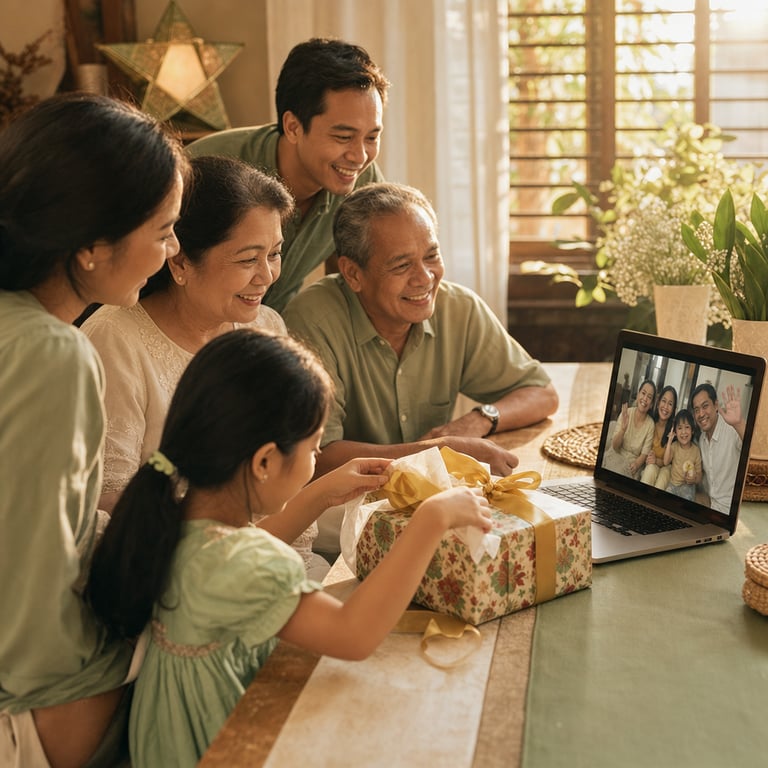
Beyond the Remittance: How Filipino Families Abroad Are Sending Gifts Home in 2026
Published on July 20, 2026
Every month, like clockwork, you send money home. Maybe it's through a remittance app, maybe a wire transfer your parents' bank set up years ago. It's routine — practical, necessary, the same amount landing in the same account on roughly the same day.
Then your nephew turns eight this weekend, and suddenly that routine feels wrong for the moment. A bank transfer doesn't say "happy birthday." It doesn't say anything, really — it just sits there as a number, indistinguishable from last month's number and next month's number. You want something that feels like it was sent for him, not for the household budget.
This is the gap a lot of Filipino families abroad — OFWs in the Gulf, nurses in Toronto and London, caregivers in Vancouver, engineers in Sydney — run into constantly. Remittance apps are built for reliability. Gifting is built for a moment. The two don't have to be the same tool, and increasingly, people are treating them as two separate things.
Remittance money and gift money aren't the same money

There's a psychological difference between money that's expected and money that's a surprise, even when the peso amount is identical. Your mother knows the remittance is coming. She's probably already budgeted it toward the electric bill or your younger sibling's tuition before it even lands. That's not a bad thing — it's exactly what remittance is for, and it's the backbone of a lot of Filipino households.
But a gift needs to sit outside that budget. It needs to be something she'd feel a little guilty spending on herself, which is precisely why she'll enjoy it more. An SM Gift Pass she can use to finally buy the pair of shoes she's been eyeing instead of restocking the pantry. A GCash gift card she can send straight to her own e-wallet and spend on something completely unnecessary, on purpose. That distinction — money that's supposed to disappear into obligations versus money that's supposed to feel like a small indulgence — is the whole reason gifting apart from remittance matters.
GCash: the gift that still feels like her own money
GCash has become close to universal in the Philippines at this point — it's not just for cash-in and bills anymore, it's how a huge number of people pay for groceries, split a bill with friends, or top up mobile data. A GCash gift card in ₱1,000, ₱1,500, ₱2,000, or ₱3,000 denominations works because it slides into money she's already using every day, without you having to guess her PIN, her bank, or her spending habits.
The nice part is what it isn't: it isn't a transfer she has to explain to anyone, and it isn't tied to a specific purchase you picked for her. If she wants to use it on a Grab ride to the market, fine. If she wants to blow the whole thing on a spontaneous Shopee order, also fine. A gift that trusts the recipient to choose tends to land better than one that assumes you know exactly what she needs — and for someone managing a household on your behalf while you're thousands of miles away, being handed a little unassigned money is its own kind of relief.
For the kids specifically, go where the excitement already is
If the occasion is a kid's birthday, don't overthink it — go where eight-year-olds in the Philippines already want to be. A Jollibee gift card in ₱300, ₱500, or ₱1,000 covers a full Jolly Spaghetti-and-fries celebration with cousins, and it doesn't require anyone at home to front the cash and wait for you to pay them back later. GrabFood gift cards do something similar for slightly older kids or a family that just wants dinner delivered without anyone cooking on the actual birthday.
There's something specific about a kid opening a gift that's theirs rather than folded into "Tita/Tito sent money for your birthday, ask Mama for some of it." A Jollibee card handed to him directly, redeemable on his own, makes the gift concrete instead of abstract. He's not waiting for an adult to convert your intention into an actual treat — he already has it.
SM Gift Pass and Grab: for the everyday needs nobody puts on a wishlist

Not every gift needs to be a treat. Some of the most appreciated ones solve a problem your family would never ask you to solve directly, because asking feels like an imposition. An SM Gift Pass works across SM's department stores, supermarkets, and specialty shops — which means it can become school supplies, a fan for the summer heat, new sandals, or groceries, depending entirely on what the household actually needs that week. You're not deciding what she buys; you're just making sure she has room to decide.
A GrabGifts card covers something similarly unglamorous but genuinely useful: rides to a doctor's appointment, errands your mother would otherwise skip because the tricycle fare adds friction to an already tiring day, or a Grab food order on a night nobody has energy to cook. None of this photographs well for a "look what I sent home" post, but it's the kind of gift that gets used within the week, which is arguably the best measure of whether a gift actually worked.
How the actual sending part works, because this is where people get stuck
If you've tried to send a gift internationally before — through international shipping, or by asking a relative to "just buy it and I'll pay you back" — you already know the friction. Shipping costs more than the item half the time. Customs holds packages for reasons nobody can predict. And the reimbursement method turns a gift into an IOU, which defeats the purpose.
Digital gift cards sidestep most of that. You buy the GCash, Jollibee, SM, or Grab card from wherever you are — London, Riyadh, Toronto, it doesn't matter what time zone you're in — and it arrives as a code or link your family redeems on their own phone, on their own schedule. There's no customs form, no waiting on a courier, no risk of the box getting lost between the airport and the barangay. If you're searching for how to send a gift card internationally without the usual shipping headache, this is functionally the whole answer: the "delivery" is just a notification landing on someone's phone in Manila or Cebu, often within minutes of you paying for it.
One cross-border gift platform, SodaGift, packages several of these Philippine-market gift cards — GCash, Jollibee, SM Gift Pass, GrabGifts, GrabFood — in one place, so you're not hopping between four different apps or regional websites trying to figure out which one actually ships e-gift cards to a PH phone number from wherever you happen to be logged in.
Choosing the occasion, not just the amount
The instinct when gifting from abroad is to ask "how much should I send?" — but the more useful question is "what's this actually for?" A ₱500 Jollibee card for a kid's birthday says something different than a ₱3,000 GCash card sent with no occasion attached at all, which itself says something different than a random Tuesday SM Gift Pass because you saw a photo of your mother's worn-out sandals on a video call. The amount matters less than whether the gift matches the moment it's meant for.
That's really the shift happening among Filipino families abroad in 2026: gifting isn't replacing remittance, and it was never meant to. It's running alongside it — a separate, smaller, more occasion-specific channel that says I remembered this particular day, distinct from the money that says I'm still taking care of things back home. Both matter. They just don't have to be the same transfer, on the same day, disappearing into the same bills.
If there's a birthday, a graduation, or just a Tuesday where you want your mother to buy something for herself instead of the household — that's the moment to send something separate from the usual routine. It doesn't need to be complicated, and it definitely doesn't need a shipping label.